
Red Flags in the Mangroves
The Island That Smelled of Death and Survival

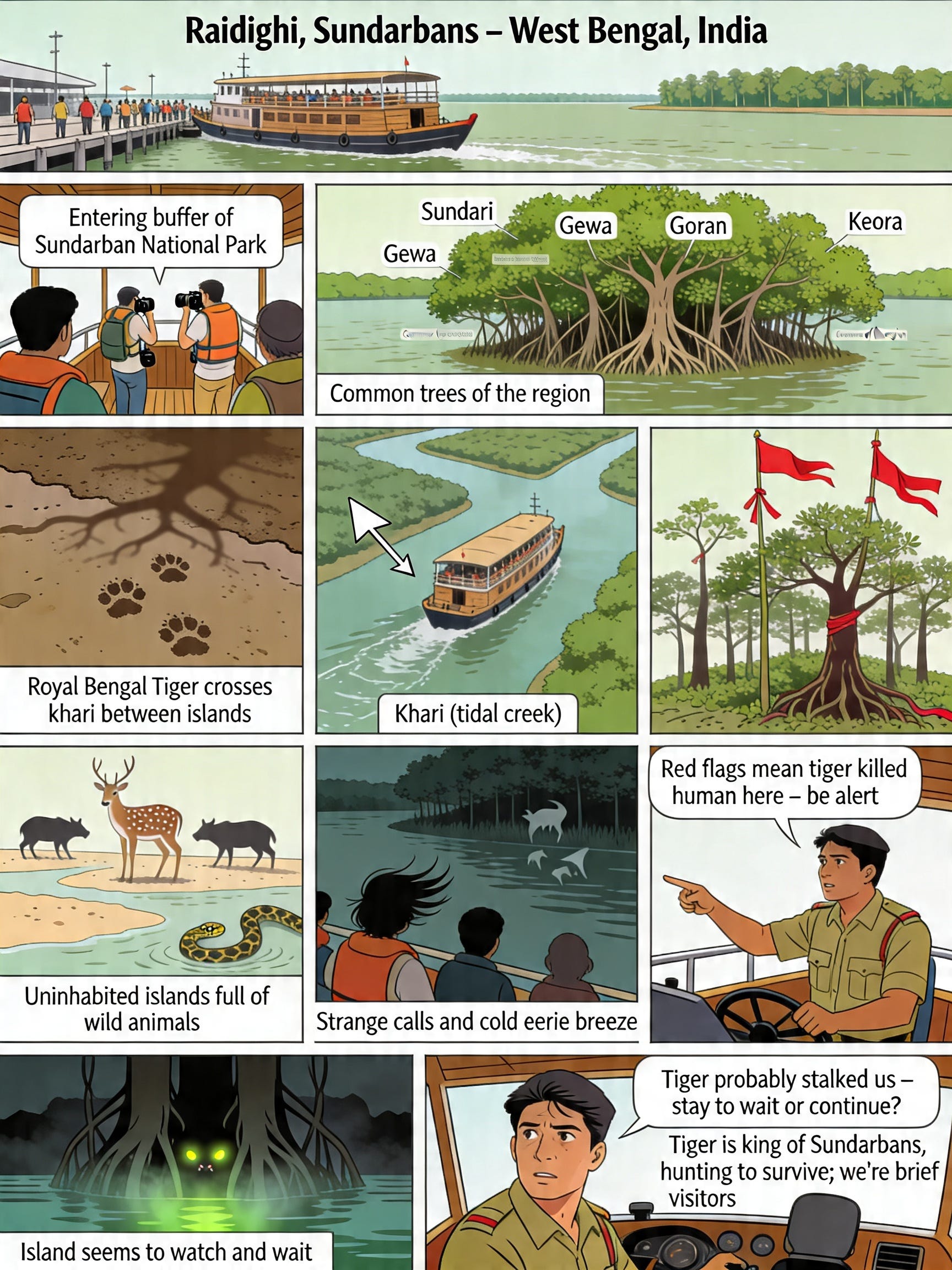
Raidighi, a small port town on the banks of a wide brown river in South 24 Parganas, was already awake when we reached the jetty. Fishermen moved like silhouettes against the pale morning light, their voices carried in broken threads over the water. On the opposite bank, far beyond the wooden boats and concrete ghat, a dark green line of forest marked the beginning of the Sundarbans.
Our launch waited for us at the edge of the jetty—a long, low steamer with peeling blue paint and a small cabin near the bow. The name, written in white Bengali letters, was half hidden under layers of river dust. As we stepped on board, the deck gave a soft creak, and the familiar mixture of diesel fumes and river smell wrapped around us. Someone handed us life jackets; we slung them over our shoulders more out of habit than fear.
“We will go into the buffer zone today,” the boatman said, starting the engine with a cough and a shudder. “Inside the Sunderban National Park, but only to the edge. Beyond that… permission, permit, time—everything is different.”
The engine’s low thrum grew steadier, and Raidighi began to slide backward in our vision as we moved away from the shore. The town, the shops, the cluster of people on the ghat—all of it slowly blurred into a strip of color. Ahead, the river opened wide and flat, reflecting a sky that was already heating up. The air felt thick, like a warm hand pressing gently on our faces.
After an hour or so, the river seemed to split into fingers. The steamer left the main channel and turned toward an island, a dense patch of green rising out of the water with no sign of human habitation. As we drew closer, the individual trees began to reveal themselves: the tall, straight sundari with their smooth grey trunks; the gewa trees with their glossy leaves; the slightly twisted goran; and, closer to the water’s edge, the keora, their roots reaching down like claws into the mud.
“These are the common trees here,” the boatman said, gesturing toward the bank. “Sundari, gewa, goran, keora. Without them, there is no Sundarban.”
The island felt alive in a way that was different from any other forest we had seen. The trees did not simply grow; they clung, gripped, held the soil together against the push and pull of the tides. Between their roots, the mud was cross-hatched with marks—crab holes, bird footprints, the narrow trails of unseen creatures.
We glided deeper into the maze.
Soon, the wide river dissolved into innumerable narrow waterways. These slender veins of water snaked between islands of various sizes, and our steamer moved among them as if unsure which path to trust. Here, every direction looked similar: water, mud, trees, sky. The channels bent and branched and rejoined, forming a labyrinth that only the boatman seemed to understand.
“These small ones are khari,” he explained, steering us into one of the narrower creeks. “Tidal canals. They join and separate the islands. You can be lost here in just a few turns.”
The water in the khari was calmer, darker, and the banks much closer. The roots of the mangroves formed tangled walls on either side, some rising above the mud like the ribs of a buried skeleton. The world grew quieter. The wind dropped. We felt the forest come closer, almost as if it leaned in to examine us.
It was here that the Sundarbans truly began to show its other inhabitants.
On a distant sandbar, we saw a small group of spotted deer, their white-dotted flanks bright against the dull mud. One lifted its head sharply as our boat passed and then trotted away into the safety of the trees. A little further along, a wild boar emerged from the undergrowth, snout digging in the mud before it vanished again as quickly as it had appeared.
“Sometimes you can see king cobra also,” the boatman remarked casually, his eyes scanning the bank. “They like the roots. But we don’t go too close.”
We followed his gaze and, for a moment, imagined a sleek, hooded form coiled in the shade, its wet scales glistening. Even without seeing one, the knowledge of such presence made us more attentive, more aware of each movement in the undergrowth.
The Royal Bengal Tiger, however, remained invisible. Yet it was the invisible thing that held the most power over our imagination.
“The tiger crosses from island to island through these khari,” the boatman said, lowering his voice as the boat slipped along another muddy bank. “Sometimes you see it swimming, sometimes you only see its pugmarks. But you must always remember—just because you cannot see the tiger does not mean the tiger cannot see you.”
We had heard stories of tigers in the Sundarbans all our lives—stories of animals strong enough to swim across broad rivers, to vanish into a thicket of roots without a sound, to watch fishermen for hours without being seen. Now, moving through this narrow waterway, those stories no longer felt like exaggerated tales. They felt like possibilities.
For a while, we lost ourselves in the rhythm of the journey: the steady chug of the engine, the soft slap of water against the hull, the occasional cry of a bird cutting through the heavy air. The day grew hotter, the sky whiter, and sweat gathered at the nape of our necks. Yet the forest around us stayed the same—cool green, patient, indifferent.
We were somewhere between two islands when the mood changed.
It happened so quietly that we could not say exactly when it began. Perhaps it was the way the light shifted, or the sudden absence of bird calls. As we approached one particular island, the air itself seemed to alter. The wind, which had been warm and sticky, now turned cooler, flowing toward us from the trees in slow, deliberate breaths.
We were talking, pointing out the twisting roots along the bank, when we realized that no one on the boat was speaking anymore. The conversation had petered out without anyone noticing. Only the sound of the engine remained, along with the rhythmic splash of water against the side of the steamer.
Then, faintly, came the calls.
They drifted from the island—low, indistinct sounds that might have been birds or animals or some mixture of both. They were not loud, not urgent, but there was a strange quality to them, as though the forest were murmuring to itself. The sounds rose and fell, wrapped in the cool wind that was now pressing against our faces.
“It’s creepy,” someone whispered behind me, “but exciting.”
I understood exactly what they meant. The island did not feel hostile, but it did not feel welcoming either. It felt… aware.
As we drew level with the island, we noticed something else: strips of red cloth tied high to the branches of several trees. They stirred slightly in the breeze, flashes of color against the heavy green.
“What are those?” I asked, pointing.
The boatman’s expression tightened. He glanced at the flags, then at us.
“Those are not decorations,” he said. “They are warnings.”
He let the words hang in the air for a moment before continuing.
“Here, a tiger killed a man. Maybe a honey collector, maybe a fisherman. The villagers or forest people came and tied these flags to remember—and to warn others. When you see red cloth like this, you must know: death has already visited this place once.”
We looked at the flags again, and they seemed to acquire a different weight. They were no longer simple pieces of cloth; they were markers of a moment when the line between hunter and hunted, between forest and human, had been crossed.
“The Sundarbans don’t forgive carelessness,” the boatman added softly.
The strange calls from the island continued, faint but unbroken. It felt as if every animal in that patch of forest was waiting for something—some signal, some movement, some shift that would set events in motion. The cool breeze that had felt soothing a few minutes ago now carried something else with it: the unmistakable smell of decay.
At first, it was just a hint—a sour note hidden in the damp air. Then it grew stronger, curling into the boat, making us wrinkle our noses.
“Do you smell that?” someone asked.
We all did. It was a pungent, heavy odor, the kind that clung to the back of the throat. In this forest, it could only mean one thing.
“Is there a dead animal nearby?” I wondered aloud. “Something killed a few days ago?”
The boatman did not answer immediately. He kept his eyes fixed on the water ahead, his hands steady on the wheel. When he finally spoke, his voice had changed—a low, almost hissing tone, as if he himself were reluctant to disturb the air around us.
“Sir,” he said, “a tiger was probably stalking us.”
We turned toward him, startled.
“It has made a kill somewhere near this island,” he went on quietly. “Maybe a deer, maybe a boar. That smell says the body is still here. The tiger wants to come back and eat in peace. But the sound of our boat, the smell of us, the vibration in the water—it has disturbed him today.”
His eyes flicked toward the dark line of trees.
“Maybe he is watching us right now from inside the forest. Maybe he swam out to the edge of the khari, then went back again when he heard the engine. The tiger is patient. He hunts to survive. He is the true king of these islands. Prey is not plenty here. Every meal matters.”
We found ourselves staring at the forest, searching for stripes between the trunks and roots, for the pale flash of a whiskered face, for the gleam of amber eyes. There was nothing—only shadows, leaves, and the quiet breathing of the trees. Yet the sensation of being watched grew stronger, like an invisible gaze resting on the back of our necks.
The boatman cut the engine slightly, letting the steamer drift a little as we passed the thickest part of the island.
“I will tell you honestly,” he said. “The tiger will come back. He will not waste his kill. Once we leave, once the water is quiet again, he will return to finish what he started. Maybe tonight. Maybe just after sunset. But he will return.”
He looked at us, measuring our expressions.
“So now you must decide,” he continued. “Do you want to stay here for some time, in the hope that the tiger will appear at the edge of the forest and you will see him?” His words came slowly, each one carefully placed. “Or do you want to move on—to other islands, other creeks—and accept that today your dream of seeing a tiger may remain a dream?”
No one spoke for a while. The question hung there, as real and heavy as the humidity around us.
The day had been unforgiving—blazing sun, air thick with sweat and salt. Yet as we passed this island, our tiredness had briefly melted away, replaced by the cool embrace of the breeze and the cold thrill of fear. Now, with the stench of death on the wind and the knowledge of a hidden tiger nearby, the Sundarbans had revealed its true character.
It was not a landscape to be visited and consumed. It was a living, breathing kingdom in which we were only temporary, fragile intruders.
As the steamer slid past the last bend of the island, the red flags slowly vanished from view. The calls from the forest faded into indistinct murmurs and then into silence. The cool wind thinned out, replaced once more by the heavy heat of the day.
We did not know where the tiger was. We did not know when he would return to his kill, to reclaim the meal that meant another day of survival in a harsh, tidal world. All we knew was that somewhere, not very far from where we had passed, the true ruler of the Sundarbans was still moving—silent, patient, unseen—while our little steamer carried us deeper into his domain, and then, eventually, back out of it.
For us, it would be a story to tell.
For him, it was simply another evening in the mangrove labyrinth, another hunt in a forest of mud, roots, and restless water.